Between Two Sizes on the Chart? Here Is How to Decide
Quick Answer: Size up for anything with a fixed structure - sports bra bands, woven shorts, jackets, and any garment where one measurement is on the boundary while another is comfortably inside. Size down only for high-elastane compression pieces where you are at the very bottom of the range and the fabric is genuinely four-way stretch. When both of your measurements straddle the gap, size up.
You measured properly, you read the chart, and your waist says medium while your hip says large. The chart has no advice for this, which is exactly where most sizing regret starts.

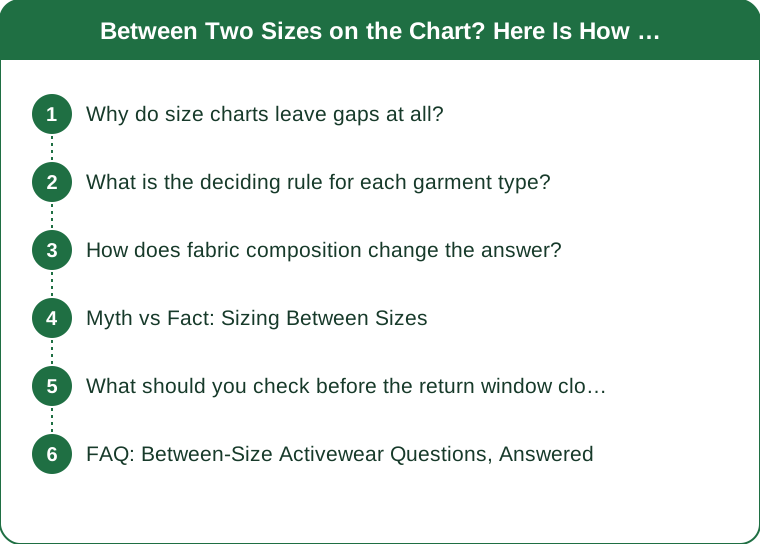
Why do size charts leave gaps at all?
Because a chart maps a three-dimensional body onto one number, and bodies do not scale uniformly.
Brands build a size range from a fit model, then grade up and down by fixed increments - typically 1 to 1.5 inches per size at the waist and slightly more at the hip. That grading assumes waist and hip grow in a fixed ratio. Real bodies vary that ratio enormously.
So the gap you are sitting in is not an error. It is the honest consequence of a system that has, say, four sizes covering a fourteen-inch range.
What matters is that the gap behaves differently depending on the garment:
- Compression bottoms have real tolerance either side, because the fabric does the accommodating
- Bra bands have almost none, because the band is a fixed circumference doing structural work
- Woven shorts and jackets have none at all, because there is no stretch to borrow from
Same gap, three different correct answers. That is why one blanket rule fails people.
What is the deciding rule for each garment type?
Work through these in order and the decision usually makes itself.
Leggings and compression bottoms. Take the hip measurement as the deciding one, not the waist. A waistband that is slightly loose can be managed with a structured band or a higher rise; a hip that is over the size boundary produces sheer fabric at the seat and thigh, which no adjustment fixes. If both straddle, size up.
Sports bras. Band first, always. If the underbust lands between two bands, size down on the band and up on the cup if the brand offers separate sizing. If the brand only offers S/M/L, size up - a too-tight band is the single most common reason a bra goes unworn.
Tops and tanks. Bust measurement decides. Between sizes with a fitted cut, size up; between sizes with a relaxed cut, size down or you get a shapeless drape.
Woven shorts and joggers. Always size up. There is no stretch to recover from a tight decision, and a drawcord makes a slightly loose waist a non-issue.
Jackets. Size up, and check shoulder width rather than chest - shoulders are the measurement that cannot be adjusted.
How does fabric composition change the answer?
Look at the elastane percentage before you decide, because it tells you how much forgiveness the garment has.
Under 8 percent elastane. Treat it almost like a woven. Minimal give, and what give exists does not recover well. Size up.
8 to 15 percent. Moderate stretch, comfortable range of about one size. Follow the garment-type rule above.
16 to 25 percent. True compression. This is the only band where sizing down is ever right, and only if you are at the very bottom of your size’s range and you actively want compression. Sizing down here because you like the number on the label produces the classic outcome: sheer fabric under load, a waistband that rolls, and a piece you stop wearing in three weeks.
Above 25 percent. Usually a specialist compression piece. Follow the brand’s own guidance rather than a general rule; these ranges are built differently.
Also check whether the fabric is two-way or four-way stretch. Two-way stretches across but not along, so a size-down decision runs out of room at the rise and the knee. Four-way has genuine room to move in both directions. If the listing does not say, assume two-way.

Myth vs Fact: Sizing Between Sizes
Myth: Sizing down gives you more compression and better support. Fact: It gives you more pressure in the wrong places and less fabric recovery. Real compression comes from fabric construction and elastane quality, not from wearing a size too small. A stretched-thin garment supports less, not more, and goes sheer under load.
Myth: Activewear always shrinks, so size up. Fact: Synthetic performance fabrics do not shrink meaningfully in a cold wash. What they do is lose recovery over time, which makes them feel looser, not tighter. Sizing up to allow for shrinkage leaves you with a piece that was too big from day one and gets baggier.
Myth: The same size fits the same across a brand’s range. Fact: Different fabrics inside one brand have different size behaviour. A soft brushed legging and a firm compression legging in the same nominal size can feel a full size apart, and both charts can be accurate.
Myth: If you are between sizes, order both and return one. Fact: This one is actually true, and it is the most reliable method there is. The caveat is to try both in the same session, on the same day, doing the same three movements - hinge, squat, and a walk - rather than judging standing still.
What should you check before the return window closes?
Do not judge a between-sizes piece standing in front of a mirror. Run this three-minute test.
The hinge. Bend forward as if picking something up. Watch the waistband at the back - if it gaps or slides down, the waist is too big or the rise is too low. Watch the seat fabric for sheerness.
The deep squat. Go to the bottom of a comfortable squat and hold five seconds. Fabric should stay opaque and the knee seam should not pull hard across the joint. Sheerness here is the clearest sign you have sized down too far.
The two-minute walk. Most slippage problems only appear after some movement. Walk around the house for two minutes and see whether the waistband stays put or begins its slow descent.
For bras, add an arm raise. Raise both arms overhead. The band should stay put on the ribcage. If it rides up, the band is too big - which is what most people mistake for the cup being too small.
Any piece that passes all four is your size, regardless of what the label says. If both sizes fail the same test in the same way, the issue is shape rather than size and a different cut is the answer.
FAQ: Between-Size Activewear Questions, Answered
Should I measure over clothes or bare?
Bare, or over a thin base layer, with the tape snug but not compressing. Measuring over a jumper adds an inch or more and will push you a full size out.
My waist and hip are two sizes apart. What then?
Go with the hip for bottoms and look for a brand with a curvier grading, a wide structured waistband, or an internal drawcord. Two sizes apart is common and a straight-graded chart simply is not built for it.
Do I size differently for high-impact versus low-impact pieces?
Slightly. High-impact bras want a snugger band; low-impact yoga pieces are more comfortable with a touch more room. The garment-type rules still hold - this shifts you within a size, not across one.
Is the model’s stated size on a product page useful?
Only as a rough signal of fit intent, since her measurements are usually near the fit model’s. It tells you how the brand wants the piece to look, not how it will sit on a body with a different waist-to-hip ratio.
TL;DR:
- Bottoms: decide on the hip measurement, not the waist; if both straddle, size up
- Bras: band decides, and a too-tight band is the top cause of unworn bras
- Under 8 percent elastane behaves like a woven - size up; only size down at 16 percent and above
- Check two-way versus four-way stretch before any size-down decision
- Test with a hinge, a deep squat, and a two-minute walk before the return window closes
Being between sizes is not a problem to solve once - it is a permanent feature of how charts are built. Once you know which measurement rules each garment type, the gap stops being a gamble and becomes a fairly predictable decision.
See It in Motion
Seen here: High Waist Yoga Leggings with Inner Pocket — shop it on bubblelime.com
Keep Reading
This article is for general informational and styling purposes only. Fit, sizing, and product availability may vary.